
If you own a home in Ipswich, you are likely familiar with sticking doors, hairline plaster cracks, or slightly uneven flooring. While many property owners blame these shifts on standard house settling, the actual culprit might be growing right in your front yard.
The unique geology of the Ipswich region, combined with water-hungry, deep-rooted tree species, creates a high-stakes scenario for concrete slab foundations. In this comprehensive guide, our certified arborists explain how local soil chemistry interacts with mature trees, how to spot the warning signs of damage, and what you can do to protect your property.
Quick Answer: Can tree roots damage foundations in Ipswich?
Yes. Tree roots can contribute to foundation movement in Ipswich homes by changing moisture levels in reactive clay soils. While roots rarely “break through” concrete slabs physically, large trees can dry surrounding soil unevenly, causing clay shrinkage, ground movement, and differential settlement.
The science of Ipswich’s reactive clay soils
Ipswich sits on highly reactive clay soils (predominantly black and grey clays). In geotechnical engineering, “reactive” means the soil acts like a literal sponge:
- The wet phase (Expansion): During heavy summer rain events, the clay minerals absorb water and swell significantly.
- The dry phase (Contraction): During dry winter spells, the moisture evaporates, causing the clay to contract, crack, and shrink.
Under normal conditions, this expansion and contraction happens relatively evenly across your property. However, mature trees completely disrupt this balance.
Why Ipswich homes are particularly vulnerable
Ipswich’s history of black soil plains means that residential areas are built directly on top of these shifting geological formations. Suburbs where reactive clay is highly common include:
- Ipswich CBD
- Brassall
- North Ipswich
- Redbank Plains
- Springfield
- Ripley
- Bellbird Park
- Karalee
- Collingwood Park
Many newer developments around Ripley, Springfield, and Redbank Plains have been built on engineered concrete slabs designed to handle soil movement. However, landscaping decisions made years later – such as planting fast-growing, water-hungry trees too close to the home – can still heavily influence ground moisture patterns and bypass engineered protections.
How tree roots actually damage foundations
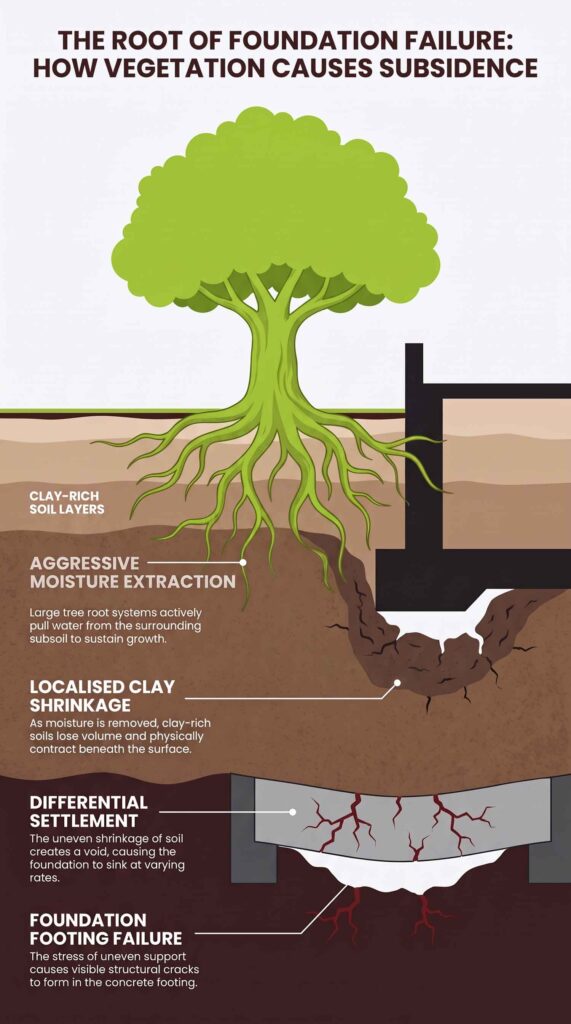
Do tree roots actually grow under concrete slabs?
A common arborist myth is that tree roots possess the physical power to violently crack open a solid, pristine concrete foundation. In reality, the damage path is almost always indirect:
- Roots exploit existing vulnerabilities: Tree roots will not break through a solid concrete slab. However, if your slab already has hairline structural cracks or plumbing leaks, roots will aggressively exploit those openings to access water.
- Surface lifting: Roots are much more likely to physically lift lighter structures like garden paths, driveways, patios, and fences.
- Moisture deprivation: The catastrophic foundation damage seen in Ipswich is overwhelmingly caused by soil moisture changes – roots sucking the clay dry, causing it to drop – rather than the roots physically pushing through the concrete.
Warning signs your Ipswich home may have tree-related foundation movement
If you suspect a tree is impacting your home, look out for these common warning signs:
Inside the home
- Sticking doors: Doors that suddenly rub against the frame or refuse to latch.
- Stuck windows: Windows that become incredibly difficult to open or close.
- Frame cracking: Cracks in the plaster branching outward from the corners of door and window frames.
- Ceiling separations: Cracks forming where walls meet ceilings.
- Uneven floors: A noticeable slope or “bounce” in your flooring.
Outside the home
- Stair-step brick cracking: Cracks running through mortar joints in an exterior brick wall.
- Slab edge movement: Gaps appearing between the bottom edge of your concrete slab and the surrounding soil.
- Paving gaps: Separation between your home’s external walls and surrounding concrete pathways or paving.
- Raised pathways: Concrete footpaths or driveways near trees that are visibly cracking or lifting.
- Exposed or damaged pipes: Recurrent plumbing blockages or slow-draining sinks caused by root intrusion.
Safe tree planting distances near Ipswich homes
While species, soil depth, and home construction methods heavily dictate safe distances, you can use these general guidelines when planning your landscape:
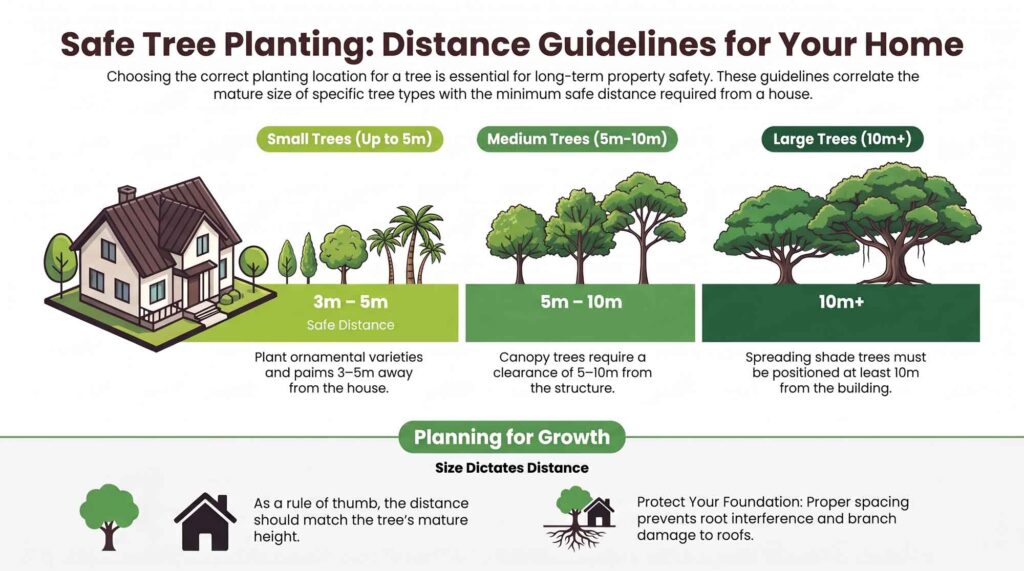
Disclaimer: Safe planting distances vary wildly based on species root architecture, specific local soil profiles, and foundation designs. Always consult a qualified local arborist before planting near structures.
High-risk tree species commonly found around Ipswich homes
Some trees present a significantly higher risk to foundation stability due to their water consumption and root structures:
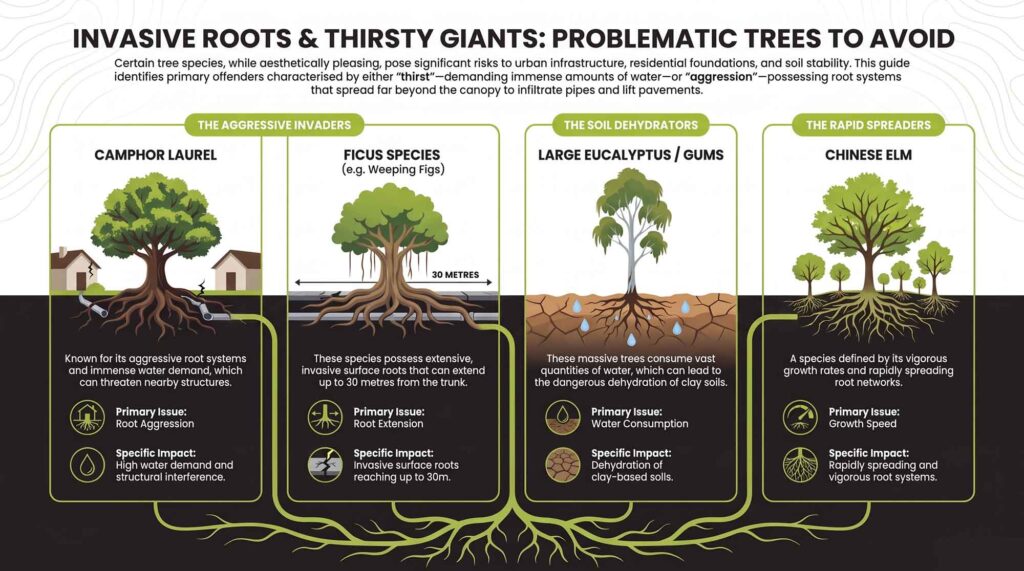
Important Note
Not every tree on this list requires immediate removal. A qualified arborist should always assess the individual tree, its distance from the structure, soil health, and overall risk factors before deciding on action.
Tree removal vs tree retention: What’s the right choice?
At Garwood Tree Services, we do not jump straight to tree removal. We weigh the safety and structural integrity of your home against the environmental value of the tree.
Removal is generally recommended when:
- The tree is actively causing measurable structural damage to your home or services.
- The species is highly invasive with aggressive root characteristics (eg. Camphor Laurel).
- The tree is structurally unstable, compromised, or diseased.
- Pruning or root management techniques cannot realistically mitigate the risk to your foundation.
Retention may be highly possible when:
- The tree is healthy, stable, and situated at an adequate distance.
- Physical barriers or deep root pruning can safely redirect root growth away from the foundation.
- The moisture extraction can be managed through strategic canopy reduction to lower the tree’s water requirements.
Professional assessment: How Garwood Tree Services assesses risk
To protect your property structure, Ryan Schilling and our qualified arborist team look at the big picture during a Hazardous Tree Assessment:
- Species identification: Understanding the water demand and root habits of the specific tree.
- Age & canopy size: Deeper, broader canopies translate to larger underground root footprints.
- Root direction & proximity: Determining if major structural roots are heading toward footings.
- Soil conditions: Assessing the clay reactivity and moisture levels around the slab.
- Visible property damage: Examining brickwork, concrete slabs, and interior doors.
- Overall tree health: Checking for signs of disease, decay, or instability that might dictate removal regardless of foundation risk.
Frequently asked questions
Can tree roots damage a concrete slab foundation?
Tree roots rarely break through solid, structurally sound concrete slabs on their own. Instead, they extract large volumes of moisture from reactive clay soils, causing the soil to shrink unevenly. This uneven shifting (differential settlement) is what ultimately causes concrete slabs to crack and drop.
How close is too close for a tree to be planted near a house?
As a general rule of thumb, large canopy trees should be planted at least 10 meters away from residential foundations. Medium-sized trees should keep a distance of 5 to 10 meters, while small ornamentals can be planted within 3 to 5 meters.
Should I remove a tree causing cracks in my home?
Not necessarily. Before proceeding with Emergency Tree Removal, an arborist should inspect the tree. It may be possible to install root barriers, perform canopy pruning to reduce water consumption, or fix underlying sewer leaks that are attracting the roots.
Can pruning stop tree root damage?
Yes. Professional canopy pruning and crown thinning reduce the leaf surface area of the tree. This directly lowers the tree’s transpiration rate (water demand), meaning the roots extract significantly less moisture from the clay soil surrounding your slab.
Who should inspect a tree near my foundation?
You should always hire a certified arborist with AQF Level 3 or Level 5 qualifications to perform a detailed arborist assessment. They possess the technical knowledge of tree biology and soil interaction required to make a safe, defensible recommendation.
Protect your home and your landscape
If you suspect a tree near your Ipswich home is contributing to foundation movement, our friendly and certified team is here to help.
We can assess the risk to your property and recommend practical, stress-free solutions – from pruning and root management through to safe, professional Tree Removal.